

ThinkTac
Grade IV Annual Science Programme
Grade IV Annual Science Programme
Regular price
Rs. 1,560.00
Regular price
Rs. 1,875.00
Sale price
Rs. 1,560.00
Unit price
per
Shipping calculated at checkout.
Couldn't load pickup availability
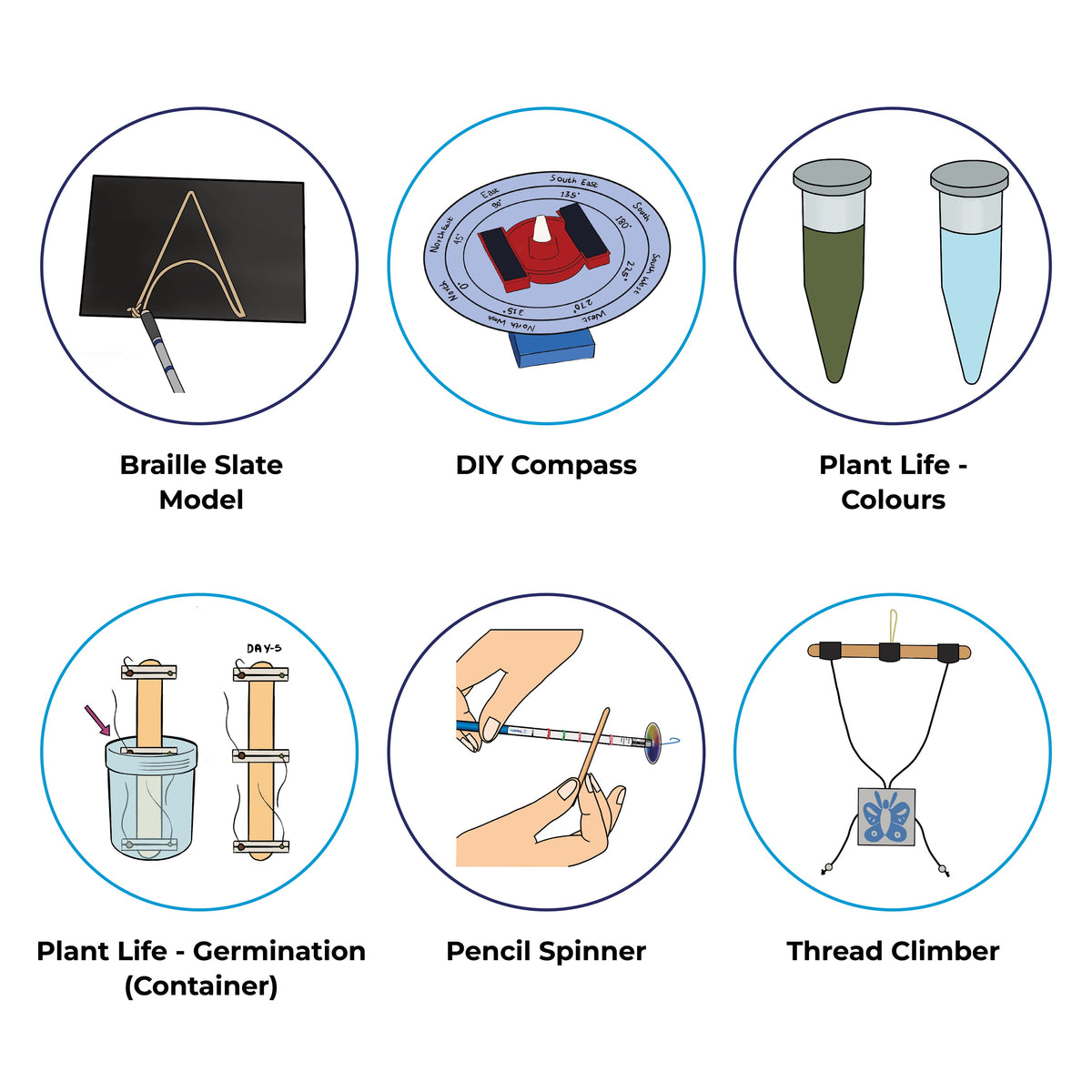
Create, enjoy and learn from ThinkTac's Experiential Science Annual Programme, which is fun-filled and can be done safely at the comfort of your home. These do-it-yourself activities are not only cool but also help you better understand what you are learning in your classroom for the year 2024-25. Please note that live facilitation will not be offered; however, in case of any questions or doubts, students can contact us on WhatsApp or by email.
Programme Features
- Material kit to make six activities will be shipped to your home.
- A activity handbook with DIY guide, hypothesis, observation and inference worksheets is included in the package.
- In case of any questions or doubts, students can contact us on WhatsApp or by email.
- You can join unLab, our online platform, to access videos and additional content
The list of activities included in this are:
| SL | TACtivity | Concept Covered |
|---|---|---|
| 1 |
Braille Slate Model |
Disability often cripples people, who don't get access to various facilities for no fault of their own. India has by far the largest population of blind children and adults on this planet, and it is imperative that they get access to the same opportunities as everyone else. Here, using a paper straw, beads, some wool and a sheet of Velcro, we recreate a woollen "Braille" slate that was invented by a young and determined blind student with his parents in 2009. |
| 2 |
DIY Compass |
The Earth happens to have its own magnetic field; in other words, it is a giant magnet in itself, because it has a rotating magnetic core. It is one of the reasons life exists on Earth, as the magnetic field provides a protective zone around the Earth preventing dangerous high energy particles penetrating our atmosphere and affecting our cells. In this TACtivity, we make a compass of our own, using magnets and a template to mount them in, to determine the orientation of the Earth's magnetic field. |
| 3 | Plant Life - Colours | Imagine being a little scientist and exploring the magical world of leaves! We can discover the colourful secrets hidden inside leaves using a cool experiment. We use a special liquid called acetone to gently take out the colours from the leaves or flowers, just like magic! Next, we put a tiny drop of this colourful liquid on a special paper, and something amazing happens! The colours start to spread out and make beautiful bands, like a rainbow painting itself. This awesome trick is called chromatography, where each colour travels at its own speed, creating a colourful masterpiece! |
| 4 |
Plant Life - Germination (Container) |
Imagine you have some magical seeds, and we're going to see how they turn into amazing plants. It's like a special adventure for our seeds! First, we need to give them a cozy bath. Yes, seeds like water just like we do! So, we're going to put some seeds fully underwater, some just a little bit in the water, and some without any water at all. It's like a seed spa day! Now, here's the fun part: we're going to watch and see which seeds start to grow into plants faster. It's like a race, but with seeds! We'll check how much they love water and air, and maybe even a bit of sunlight. |
| 5 |
Pencil Spinner |
Vibrations of a material have many wonderful effects: vibrating membranes make a sound, vibrating strings make a wave and vibrating stars create gravitational waves! In this age-old TACtivity (called gee-haw whammy diddle by the Native Americans who invented it 200 years ago), we see the simple (yet not fully understood!) phenomenon of vibrations in a pencil causing perfect circular motion of a spinner! Can you change the direction of the spinner by saying "gee" or "haw"?? |
| 6 |
Thread Climber |
Friction is a resisting force that exists between any two surfaces that are in contact with each other, whether moving or stationary. In this TACtivity, we will make a simple toy - using cotton threads, cardboard sheet, ice cream stick and beads - which can climb up and help us understand the concept of friction. |