

ThinkTac
Grade IX Annual Math Programme
Grade IX Annual Math Programme
Couldn't load pickup availability
Create, enjoy and learn from ThinkTac's Experiential Science Annual Programme, aligned with the NCERT curriculum, which is fun-filled and can be done safely at the comfort of your home. These do-it-yourself activities are not only cool but also help you better understand what you are learning in your classroom for the year 2024-25. Please note that live facilitation will not be offered; however, in case of any questions or doubts, students can contact us on WhatsApp or by email.
Programme Features:
- Material kit to make six activities will be shipped to your home.
- A activity handbook with DIY guide, hypothesis, observation and inference worksheets is included in the package.
- In case of any questions or doubts, students can contact us on WhatsApp or by email.
- You can join unLab, our online platform, to access videos and additional content
| SL | TACtivity | Concept Covered |
|---|---|---|
| 1 |
Root Spiral |
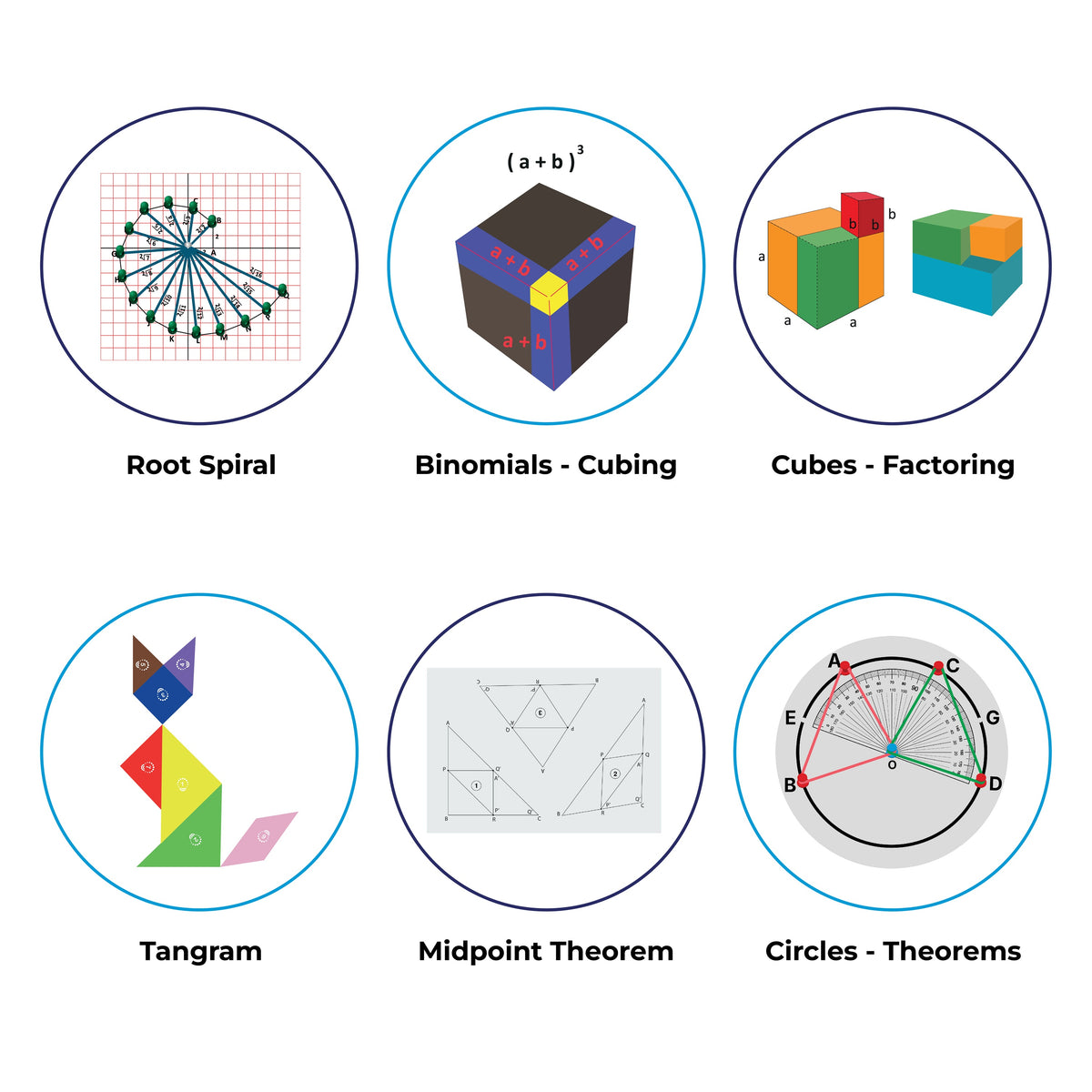
A real number, in mathematics, is a quantity that can be expressed as an infinite decimal expansion, in other words, any number that can be represented somewhere along a number line. All positive and negative integers, zero, rational numbers and irrational numbers are considered real numbers. In this TACtivity, we construct an ingenious spiral that represents the square root of numbers on a line. |
| 2 |
Binomials - Cubing |
Algebraic expressions are classified as monomials, binomials and polynomials, where monomials are algebraic expressions with one term, binomials with two monomials, and polynomials with two or more monomials. Multiplying a binomial by itself three times gives the cube of a binomial. In this TACtivity, we use 3D algebraic tiles to visualise the cubing of binomials. |
| 3 |
Cubes - Factoring |
Algebraic expressions are classified as monomials, binomials and polynomials, where monomials are algebraic expressions with one term, binomials with two monomials, and polynomials with two or more monomials. Polynomials can be expressed in a simpler form by factoring them. Factoring helps write algebraic expressions in a simpler form by expressing them as factors. Multiplying the factors gives the original number/algebraic expression, etc. In this TACtivity, we use nets of a concave prism, cuboids and cubes to visualise the factoring of the sum and difference of two cubes. |
| 4 |
Tangram |
A tangram is a dissection puzzle consisting of seven flat polygons, called tans, which are put together to form shapes. In this TACtivity, we use a template to get polygon shapes, arrange them to see other different polygon shapes and have fun making animal and bird shapes too! |
| 5 |
Midpoint Theorem |
In geometry, the midpoint theorem helps us to find the missing values of the sides of the triangles. It establishes a relation between the sides of a triangle and the line segment drawn from the midpoints of any two sides of the triangle. The midpoint theorem states that the line segment drawn from the midpoint of any side to the midpoint of any other side of a triangle is parallel to the third side and is half of the length of the third side of the triangle. In this TACtivity, we explore the concept of the midpoint theorem, using an A4 sheet. |
| 6 |
Circles - Theorems |
Circle-related theorems encompass fundamental principles governing relationships within circular shapes. These theorems often involve angles, lengths, and geometric properties of circles and their components, such as chords, secants, and tangents. Mastery of these theorems is essential for solving various geometric problems and proofs involving circles. In this TACtivity, we utilise a circular disc and rubber bands to explore some of the theorems related to circles. |