

ThinkTac
Grade IX Annual Science Programme
Grade IX Annual Science Programme
Couldn't load pickup availability
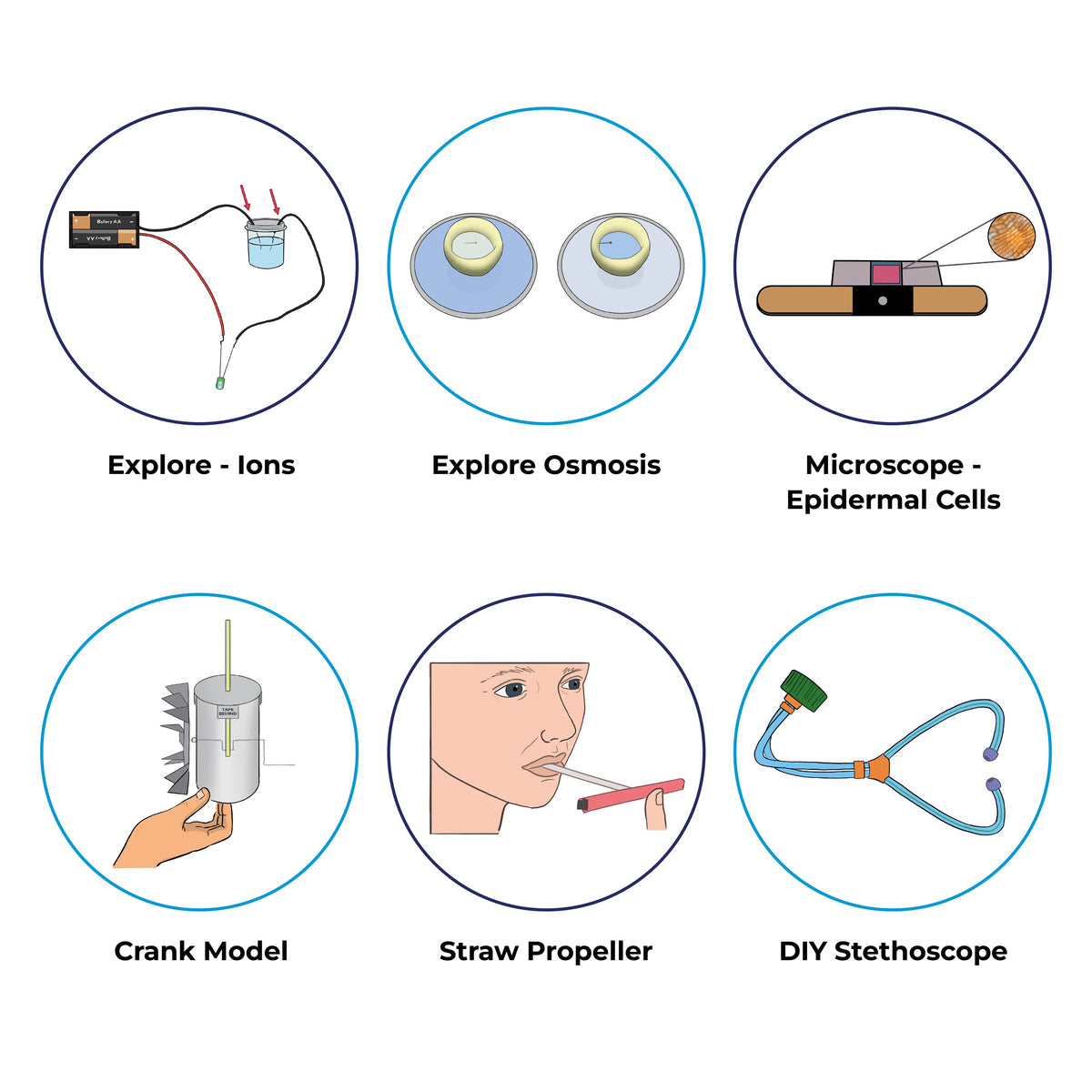
Create, enjoy and learn from ThinkTac's Experiential Science Annual Programme, aligned with the NCERT curriculum, which is fun-filled and can be done safely at the comfort of your home. These do-it-yourself activities are not only cool but also help you better understand what you are learning in your classroom for the year 2024-25. Please note that live facilitation will not be offered; however, in case of any questions or doubts, students can contact us on WhatsApp or by email.
Programme Features:
- Material kit to make six activities will be shipped to your home.
- A activity handbook with DIY guide, hypothesis, observation and inference worksheets is included in the package.
- In case of any questions or doubts, students can contact us on WhatsApp or by email.
- You can join unLab, our online platform, to access videos and additional content
| SL | TACtivity | Concept Covered |
|---|---|---|
| 1 |
Explore - Ions |
We are often told that pure distilled water doesn't conduct electricity. Why then are we warned to not bring electrical connections in contact with water? What is it in water that does cause it to conduct electricity, if at all? Here, we test the conductivity of acidic and basic solutions using a basic circuit with a battery and LEDs. |
| 2 | Explore Osmosis |
Osmosis is the process by which solvent molecules move from a less concentrated to a more concentrated solution through a semi-permeable membrane. This process is vital in all kinds of biological scenarios (in our kidneys, in plants etc), as well as human applications (e.g. water filters). In this TACtivity, we use a potato to demonstrate two different kinds of osmosis - endosmosis and exosmosis. |
| 3 | Microscope - Epidermal Cells |
The onion peel is so fascinating because with your bare hands, you can easily peel off a unicellular layer from this very tasty stem vegetable. This peel can then be placed on a microscope slide and "stained", so that you may observe the wonderful brick-like structure of onion plant cells through your own DIY Microscope. |
| 4 |
Crank Model |
Ever wondered how the linear motion of pistons makes your car axle rotate, or how the linear motion of the shafts in a railway locomotive make its wheels rotate? It turns out, that with a wee bit of engineering, motion can be "translated" from one direction form into another! In this TACtivity, we see exactly how by making a Crank out of a metal wire in a bottle. As you rotate the crank, the straw it's attached to goes up and down! |
| 5 |
Straw Propeller |
Newton's Third Law of Motion is one of the most beautifully succinct laws. So much so, that it seems obvious to most who read it. However, few really understand the law and this TACtivity - made by inserting a thin straw through holes made in the middle of a fat straw - goes a long way in addressing many of those misconceptions and clarifying several other fundamental concepts in physics. |
| 6 |
DIY Stethoscope |
A stethoscope is a medical instrument, used to listen to a patient's heartbeat or breathing, and typically has a small disc-shaped chest piece that is placed against the chest, and two tubes connected to earpieces. In this guide, we will learn to make a stethoscope, using a plastic bottle cap, two plastic tubes, thick binding wire to form the shape of a stethoscope, foam pieces as earplugs and a balloon as a diaphragm. |