

ThinkTac
Grade V Annual Science Programme
Grade V Annual Science Programme
Regular price
Rs. 1,560.00
Regular price
Rs. 1,875.00
Sale price
Rs. 1,560.00
Unit price
per
Shipping calculated at checkout.
Couldn't load pickup availability
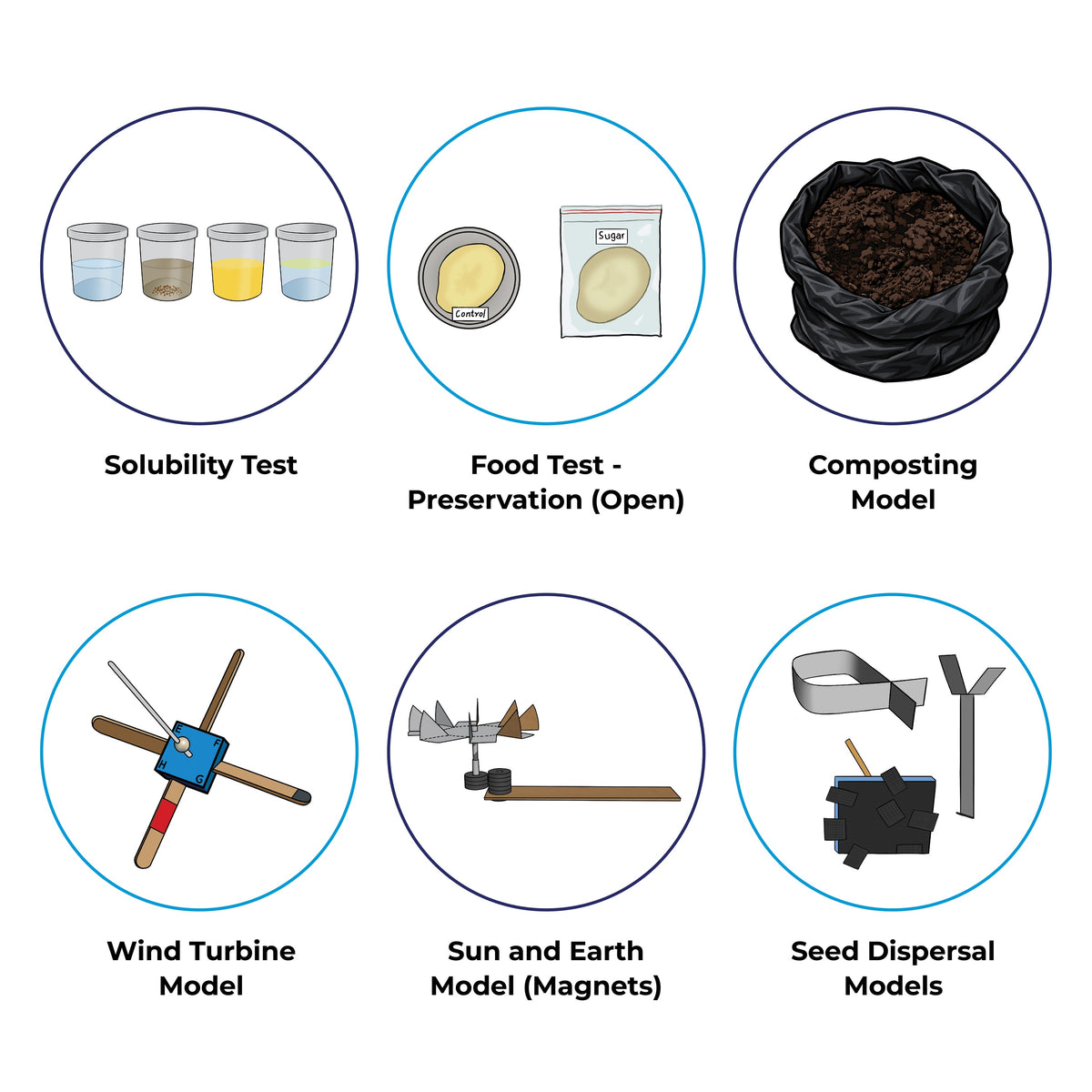
Create, enjoy and learn from ThinkTac's Experiential Science Annual Programme, aligned with the NCERT curriculum, which is fun-filled and can be done safely at the comfort of your home. These do-it-yourself activities are not only cool but also help you better understand what you are learning in your classroom for the year 2024-25. Please note that live facilitation will not be offered; however, in case of any questions or doubts, students can contact us on WhatsApp or by email.
Programme Features:
- Material kit to make six activities will be shipped to your home.
- A activity handbook with DIY guide, hypothesis, observation and inference worksheets is included in the package.
- In case of any questions or doubts, students can contact us on WhatsApp or by email.
- You can join unLab, our online platform, to access videos and additional content
The list of activities included in this are:
| SL | TACtivity | Concept Covered |
|---|---|---|
| 1 |
Solubility Test |
Some substances dissolve easily in water, while others do not. For example, salt and sugar dissolve quickly, while sand does not. This is called solubility, which helps us understand how different materials interact with water. In this TACtivity, we test the solubility of various substances in water. |
| 2 |
Food Test - Preservation (Open) |
There are many ways to preserve food from rotting, and the examples are all around us: refrigeration, desiccation, pickling and many more methods. One of the classic ways to preserve food is by adding preservatives, either natural or synthetic. In this TACtivity, we test various food samples with some common preservatives, and over the course of about a week, observe which ones work best for which samples! |
| 3 |
Composting Model |
Biodegradable waste can be recycled into a nutrient-rich fertiliser for plants and crops, by the process of composting. Composting is a process of decomposing organic waste with the help of micro-organisms like fungi, bacteria, etc. In this TACtivity, we will learn how to compost organic waste with cocopeat, sufficient sunlight and proper aeration. |
| 4 |
Wind Turbine Model |
Humans have learnt how to harness energy from various sources, to make certain tasks mechanised, produce electricity etc. The energy is often harnessed through the use of turbines. In an increasingly warming planet, it is imperative that we expand our capacity of harnessing renewable sources of power. One such example is a Wind Turbine. In this TACtivity, we make a Wind Turbine Model using foam and ice-cream sticks, which are placed at different angles to observe its effect on the speed of the turbine when held under a fast-spinning ceiling fan. |
| 5 |
Sun and Earth Model (Magnets) |
Any object that revolves does so because of a force that is pulling the object towards the centre of revolution. In the case of a mass revolving around another mass, that "centre" happens to be the system's centre of mass. For two objects of vastly different mass, the centre of mass is effectively at the location of the centre of mass of the heavier mass, as in the case of the Sun and Earth. In this simple model, we use the attractive force between magnets and a cardboard wind turbine to simulate the Earth spinning around its axis and revolving around the Sun! |
| 6 |
Seed Dispersal Models |
Seed dispersal is the movement or the transport of seeds from one place to another by a vector (animal, wind, water). Seeds are dispersed naturally and manually. In this TACtivity, we will learn the different patterns and modes of seed dispersal using very simple materials. |