

ThinkTac
Grade VI Annual Math Programme
Grade VI Annual Math Programme
Regular price
Rs. 1,560.00
Regular price
Rs. 1,875.00
Sale price
Rs. 1,560.00
Unit price
per
Shipping calculated at checkout.
Couldn't load pickup availability
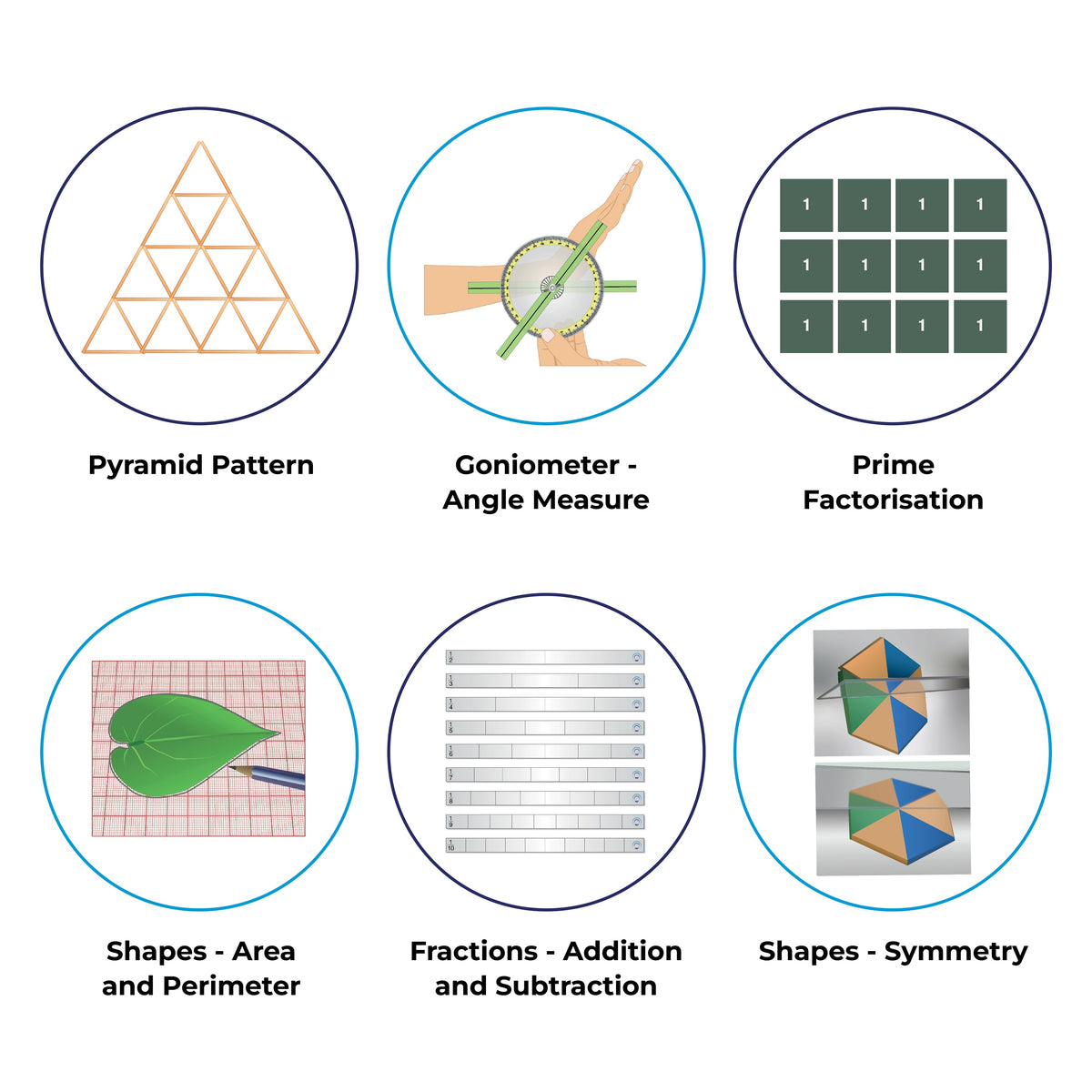
Create, enjoy and learn from ThinkTac's Experiential Science Annual Programme, aligned with the NCERT curriculum, which is fun-filled and can be done safely at the comfort of your home. These do-it-yourself activities are not only cool but also help you better understand what you are learning in your classroom for the year 2024-25. Please note that live facilitation will not be offered; however, in case of any questions or doubts, students can contact us on WhatsApp or by email.
Programme Features:
- Material kit to make six activities will be shipped to your home.
- A activity handbook with DIY guide, hypothesis, observation and inference worksheets is included in the package.
- In case of any questions or doubts, students can contact us on WhatsApp or by email.
- You can join unLab, our online platform, to access videos and additional content
The list of activities included in this are:
| SL | TACtivity | Concept Covered |
|---|---|---|
| 1 |
Pyramid Pattern |
Algebra is a branch of mathematics that deals with manipulating symbols and following rules for rearranging them, using arithmetic operations such as addition and multiplication, etc. We use algebra to work with expressions and to play with variables and expressions. In this TACtivity, we use sticks to make a pyramid shape, to understand how patterns and algebra are connected while describing the whole pattern, using a simple maths expression. |
| 2 |
Goniometer - Angle Measure |
Joints in our body are essential to carry out any physical activity. Different kinds of joints allow different kinds of movements. We can use a goniometer to measure the range of movement at the joint. In this TACtivity, we will make our own goniometer, using a protractor, plastic strips, a nut and a bolt. |
| 3 |
Prime Factorisation |
A number can be divided exactly by two smaller numbers (known as divisors or factors). Multiplying the divisors (or factors) gives the original number and is known as factorisation. When the two divisors are prime numbers, it is known as prime factorisation. All non-zero integers can be factorised to their prime factors. Prime numbers themselves have only two factors: 1 and the number itself. All other numbers have 3 or more prime factors, allowing you to represent the numbers in rectangular blocks. For example, pick any number smaller than 50 and make rectangles, using 2D Unit tiles such that the area of the rectangle is equal to the number you have selected. Repeat this exercise for 5 numbers and record the length of the sides of the rectangles you made. Identify the numbers for which you can't make more than one size of rectangles. What type of numbers are they? |
| 4 |
Shapes - Area and Perimeter |
A simple, effective, and enjoyable way to measure the area and perimeter of regular and irregular shapes, such as boxes, bangles, leaves, etc., is by tracing the shape on a graph paper. |
| 5 |
Fractions - Addition and Subtraction |
When an object is divided into equal parts, each part is known as a fraction. A fraction is represented as p/q, where 'p' denotes the number of parts one has and is also known as the numerator and 'q' denotes the total number of parts an object has been divided into, also known as the denominator. In this TACtivity, we represent fractions on a number line and explore the various operations performed on them using fraction strips. |
| 6 |
Shapes - Symmetry |
Line symmetry occurs when an object can be divided into two identical halves by a line, with each half being a mirror image. Rotational symmetry happens when an object looks the same after being rotated around a central point by a certain angle. Both types of symmetry are found in nature and shapes, like butterflies or stars. In this TACtivity, we use different geometric shapes to create patterns to explore line and rotational symmetry. |