

ThinkTac
Grade X Annual Science Programme
Grade X Annual Science Programme
Couldn't load pickup availability
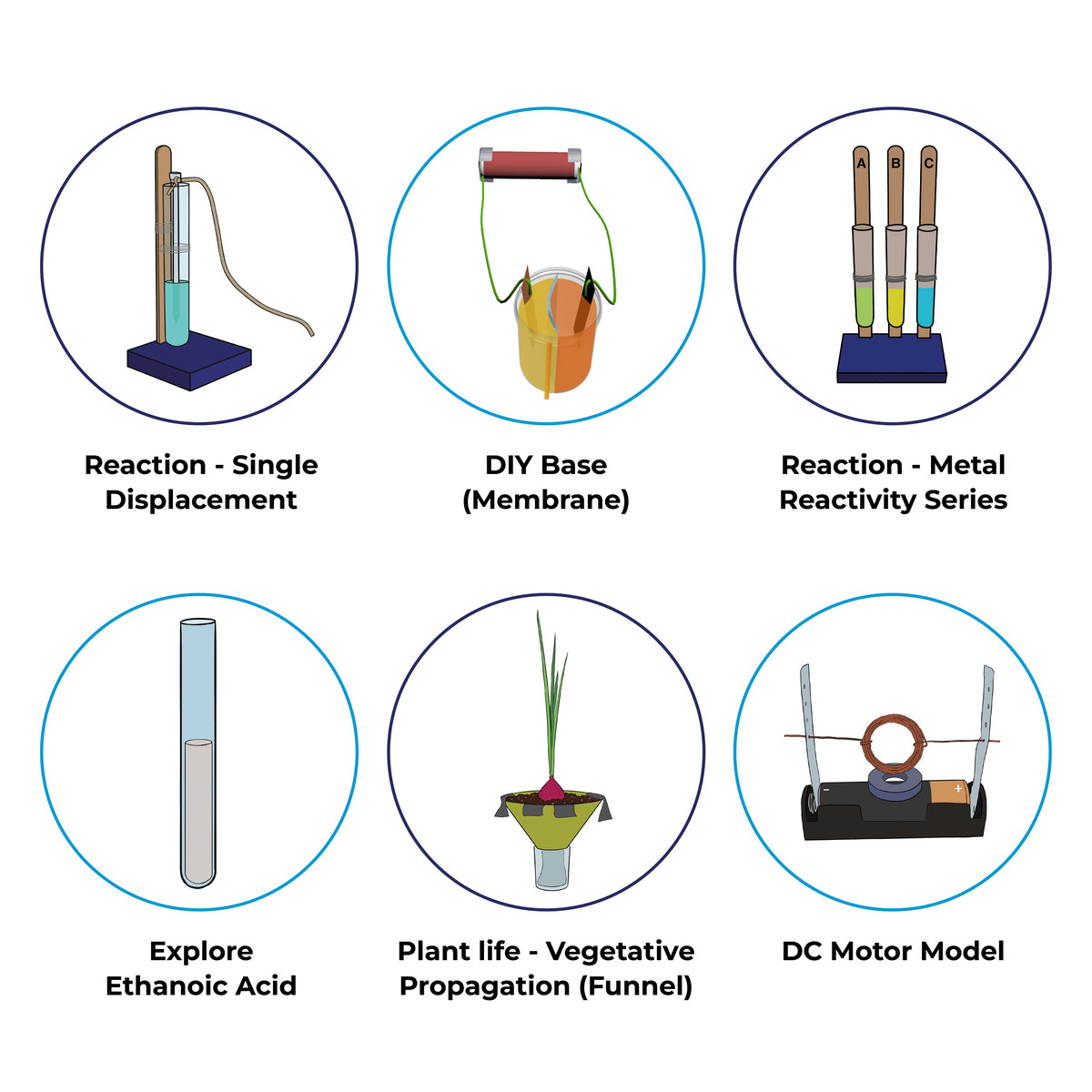
Create, enjoy and learn from ThinkTac's Experiential Science Annual Programme, aligned with the NCERT curriculum, which is fun-filled and can be done safely at the comfort of your home. These do-it-yourself activities are not only cool but also help you better understand what you are learning in your classroom for the year 2024-25. Please note that live facilitation will not be offered; however, in case of any questions or doubts, students can contact us on WhatsApp or by email.
Programme Features:
- Material kit to make six activities will be shipped to your home.
- A activity handbook with DIY guide, hypothesis, observation and inference worksheets is included in the package.
- In case of any questions or doubts, students can contact us on WhatsApp or by email.
- You can join unLab, our online platform, to access videos and additional content
| SL | TACtivity | Concept Covered |
|---|---|---|
| 1 | Reaction - Single Displacement |
A chemical reaction in which one element is replaced by another in a compound is called a single-displacement reaction. In this TACtivity, we react iron with copper sulphate, resulting in the iron replacing copper and producing iron sulphate. |
| 2 |
DIY Base (Membrane) |
Bases are chemical substances that taste bitter, feel soapy and have a pH value above 7. Bases turn Turmeric (Haldi) powder to Vermilion (Kumkum), Bromothymol blue indicator to blue in colour, Red litmus paper to blue in colour. In this TACtivity, we are going to prepare a base by the electrolysis of brine (concentrated table salt solution). |
| 3 |
Reaction - Metal Reactivity Series |
The ability of a metal to react with other chemicals is an important property of the metal and is called its Reactivity. In this TACtivity we take three metals - Copper, Iron and Magnesium - with different reactivities and test their behaviour by placing them in copper sulphate solution. |
| 4 |
Explore Ethanoic Acid |
Identifying compounds is an important aspect of Organic Chemistry. In this TACtivity, we conduct different tests to identify Acetic Acid or Ethanoic Acid, a common organic compound available in every kitchen. We test physical properties like smell and solubility and chemical properties including pH, reaction with sodium bicarbonate, sodium carbonate and Sodium Hydroxide. |
| 5 |
Plant life - Vegetative Propagation (Funnel) |
In vegetative propagation, new plants are produced from different vegetative parts of a plant, such as leaves, stems, buds, and roots. Here, we use wick-based irrigation system to grow a potato/onion plant by Vegetative Propagation, i.e. by planting directly in hydrated gel beads. |
| 6 |
DC Motor Model |
This amazingly simple model of a DC Motor allows you to experience various facets of electromagnetism first-hand. The simple design and materials allow you to play with, experiment and tinker with this model and discover the properties of electricity and magnetism yourself. Current from the battery flowing through the copper coil makes it an electromagnet (Oersted's Law), which in turn interacts with permanent magnets, providing a thrust for the copper coil to rotate. All electric motors in the world work on the same principle. Here you make, play with, tinker and experiment with a brilliantly simple model first-hand. |